

Our solution to mitigate space debris
Autonomous Deorbit Devices (DDs) are compact subsystems designed to guarantee the post-mission disposal of space objects in Low Earth Orbit (LEO), aligned the increasingly strict regulatory deadlines. These systems can be directly integrated into satellites prior to launch, particularly in missions that require regulatory compliance (e.g., the U.S. FCC 5-year rule or ESA’s Zero Debris Approach). Alternatively, DDs can be deployed as payloads aboard In-Orbit Servicing (IoS) vehicles that install them onto already existing, non-functional satellites or debris objects during Active Debris Removal (ADR) missions. Thanks to their autonomous operation, DDs are especially useful for legacy satellites or debris lacking onboard propulsion or power.
At the heart of these devices is the Electrodynamic Tether (EDT). Unlike other deorbiting technologies, EDTs enable the development of subsystems that are fully autonomous; generarating their own power via small solar arrays, maintain communication through independent telemetry and telecommand systems, and perform attitude control (e.g., detumbling) without needing any input from the host satellite. Note that this technology can also be non-autonomous for a more compact and cheap subsystem
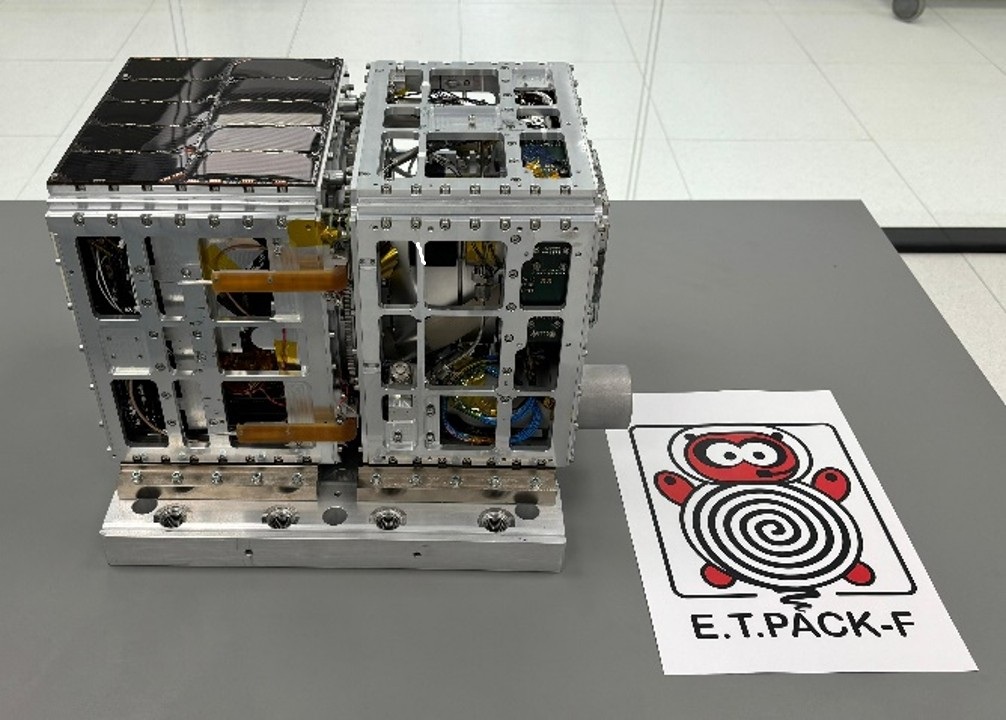
The first prototype of this technology, called E.T.PACK-F, has been developed in the framework of the European Innovation Council (EIC) projects E.T.PACK and E.T.PACK-F. E.T.PACK enabled the development of a first functional prototype, while E.T.PACK-F has matured the technology up to flight readiness. The E.T.PACK-F prototype is a 12U device with a total mass of 20 kg and includes a 420-meter electrodynamic tether; targetting satellites over 200kg of weight. Its in-orbit demonstration is scheduled for 2026/2027 and will be led by PERSEI Space. The mission is funded through the EC/ESA Flight Ticket Initiative.
Building on the lessons learned from the E.T.PACK-F in-orbit demonstration, PERSEI Space wants to develop PEARSON, its first commercial product. PEARSON will offer enhanced performance compared to the prototype, including a longer tether (around 1 km), optimized subsystems for higher reliability and lower cost, and customizable interfaces adapted to customer needs. Commercialization is expected to start in 2027/2028, targeting the deorbiting of medium to large objects such as satellites, upper stages, and payload adapters.